Glow Up or Go Home: How Bad Lighting Is Quietly Murdering Your Party Atmosphere
Let's be real for a second. You've done everything right. The playlist is a certified banger from start to finish. The drink setup looks like something off a catering Instagram page. The fit is immaculate. And then your guests walk in, blink under the aggressive glow of your ceiling light, and suddenly the whole energy feels like a Sunday afternoon at a DMV.
Lighting is the silent assassin of good parties. Nobody talks about it until it's already ruined the night — and by then, you're two hours in, wondering why the room feels flat even though the music is hitting. The truth? You can't separate how a space feels from how it looks, and how it looks is almost entirely controlled by light.
So let's fix it. Three moves. No electrician required.
Why Lighting Hits Different Than You Think
Before we get into the how, let's talk about the why — because understanding this will change the way you host forever.
Light communicates mood before a single word is spoken or a single beat drops. Bright, white light signals alert, functional, exposed. It's the lighting of grocery stores, office buildings, and hospital waiting rooms. It tells your nervous system to stay sharp. That is the opposite of what you want at a party.
Warm, low, layered light signals safe, intimate, alive. It's the lighting of jazz clubs in New Orleans, rooftop bars in Atlanta, and every house party you've ever attended that you still talk about years later. It tells people to relax, to move, to connect.
Here's the kicker: the music doesn't matter if the lighting is fighting it. You can have a Kendrick Lamar set bumping through a $2,000 speaker system, and if your guests are standing under a bare 100-watt bulb, the room will still feel like an interrogation. Light sets the emotional stage. Everything else performs on top of it.
Move 1: Kill the Overhead and Go Ambient First
The first move is the most important — and the most counterintuitive. Turn off your main overhead lighting. Yes, all of it. Or at the very minimum, dim it down to almost nothing.
Overhead lighting is the enemy of atmosphere. It flattens faces, kills shadows, and makes every corner of the room equally visible — which means equally uninviting. Great party spaces have depth. They have bright spots and dark corners, areas that draw people in and areas that feel like a secret.
Ambient lighting is your foundation. Think floor lamps, table lamps, LED strip lights tucked behind furniture, or plug-in sconces placed strategically around the room. The goal is to fill the space with a warm glow rather than a direct beam. Warm white or soft amber tones (look for bulbs in the 2700K–3000K range) are your best friends here. They're flattering, they're inviting, and they make everyone look like they woke up like this.
Budget tip: A set of smart bulbs — Govee, Philips Hue, or even the Amazon Basics versions — lets you dial the warmth and brightness from your phone. You can set the whole room in about ten minutes and adjust on the fly as the night evolves. We're talking $30–$60 for a full room transformation. That's less than one bottle of decent tequila.
Move 2: Layer in Accent Lighting to Create Visual Interest
Once your ambient base is set, it's time to add dimension. Accent lighting is what separates a decent vibe from a memorable one. This is where personality lives.
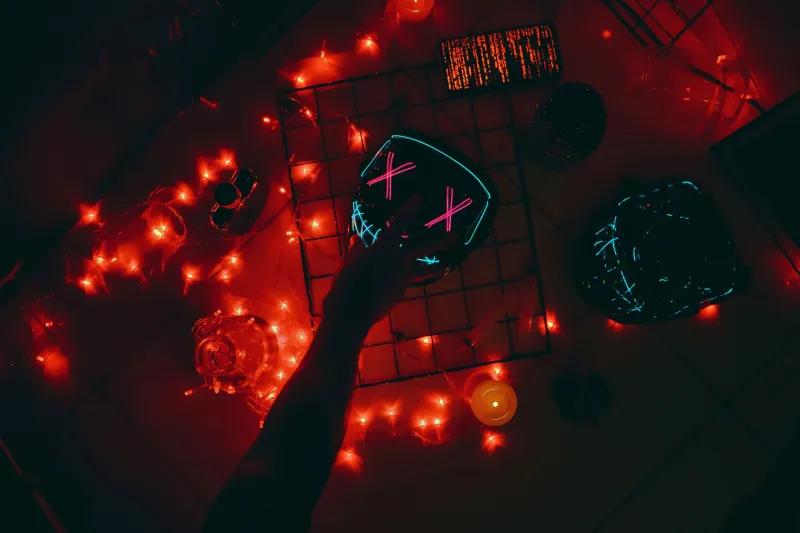
Accent lights are targeted — they highlight specific areas, objects, or moments in the room. Think a LED strip behind your bar cart that makes the bottles glow like a nightclub shelf. A few candles (real or flameless) clustered on a side table. A neon sign with a phrase that fits the energy of your crew. String lights draped along a wall or across a ceiling to create that rooftop-under-the-stars feel even if you're in a third-floor walkup in Chicago.
The rule here is intentionality. Every accent light should be pointing at something worth looking at — your drink setup, a statement wall, the DJ corner, the photo area if you've got one. You're directing your guests' attention without them even realizing it. That's the art of hosting.
Color also plays a role in this layer. A few strategically placed LED lights in a deep purple, midnight blue, or low red can shift a room from "apartment hangout" to "underground lounge" instantly. Don't overdo it — one or two color accents mixed with your warm ambient base is the move. Going full rainbow is a vibe for a kid's birthday party, not a grown and sexy function.
Move 3: Activate the Dancefloor Zone
If your party has a designated spot where people are going to actually move — whether that's your living room, a cleared-out dining area, or a backyard setup — that space needs its own lighting moment. This is where you get to have a little fun.
The dancefloor zone should feel different from the rest of the room. It needs energy, motion, and just enough visual stimulation to make people forget they're self-conscious. A slow-moving LED projector that casts stars or geometric patterns across the ceiling. A portable DJ light with rotating beams. A smart bulb set to slowly pulse in sync with the bass. You don't need a full production rig — you need something that signals to your guests' bodies that this is the zone where it goes down.
Timing matters too. Don't activate the dancefloor lighting the moment the first guest arrives. Let the room fill up, let the ambient layers do their work for the first hour, and then — right when the playlist shifts from background to foreground — hit the switch. That transition is a moment. It tells everyone: we're in it now.
The Bonus Rule Nobody Tells You
Here's the thing they don't put in any party planning guide: check your lighting at night, at the actual time your party starts, with the same number of people you expect to have in the room.
Lighting that looks perfect in an empty apartment at 7 PM can look completely different when 25 people are in the space at 11 PM generating body heat and blocking your lamps. Do a walk-through. Adjust. Trust your eyes.
Also — and this is non-negotiable — turn off the bathroom light or at least swap it to a warmer bulb. Nothing breaks the spell of a perfectly lit party like a guest disappearing into a fluorescent-lit bathroom and coming back looking like they just got a physical. The details matter.
Lighting isn't an afterthought. It's the first thing people feel when they walk through your door, even if they can't name it. Get this right, and everything else — the music, the drinks, the conversation — lands harder. Get it wrong, and you're just hosting a very expensive hangout in a sad apartment.
The glow is the vibe. Set it intentionally.